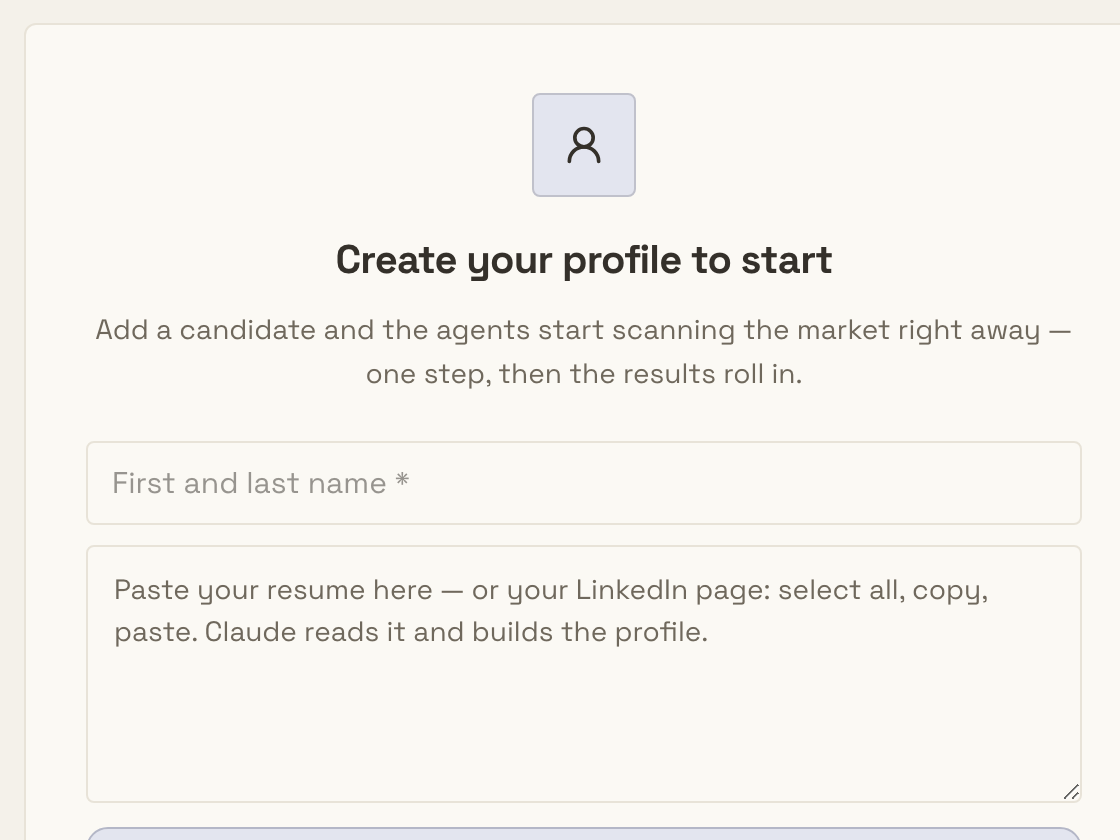
It starts empty
One card on the whole screen: create the person you are hunting for. Nothing else is shown, because nothing else matters yet.
Qiksy Offer runs Claude agents that sweep the whole market (company sites, ATS, boards, hiring threads and early signals), match roles to your profile, draft tailored applications, and keep watching so new roles come to you. Every IT profession: developers, QA, PMs, designers, DevOps.
First finds land in three to eight minutes, a full sweep takes about fifteen. This is why: every posting is opened and read in full, not skimmed from its headline. You can close the tab; the run keeps going on your own machine.
The wording in the log is the tool’s own. The run is redrawn here so you can see what a search looks like without having to start one.
Job hunting is hours of tab-juggling and copy-paste. Qiksy Offer turns it into a queue of agents.
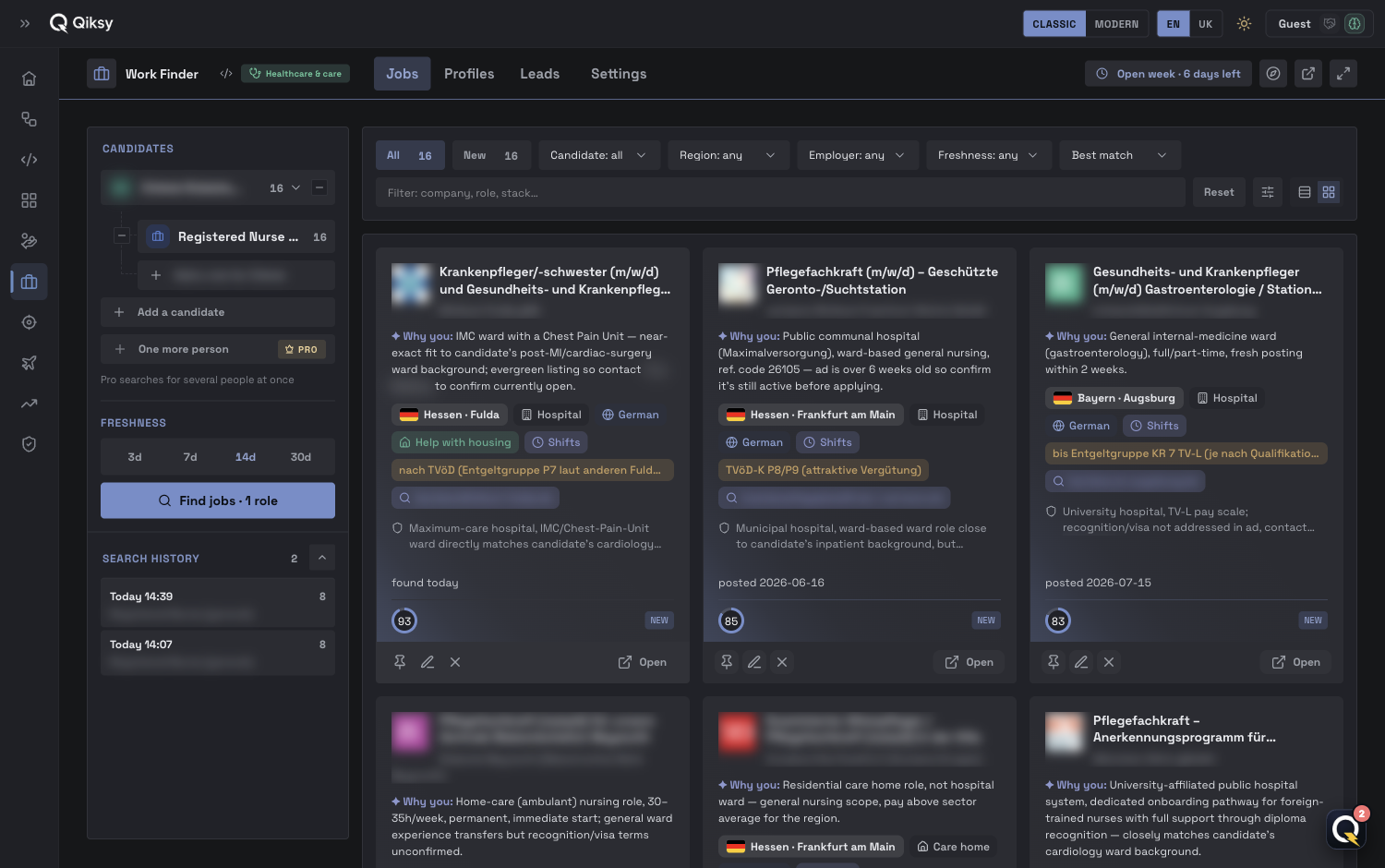
Taken from the working tool on a live database, not from a mockup. Every card: the role, a match score, the agent’s reasoning against that specific résumé, the region, the conditions and the pay scale.
Stack, level, work format, English. The agent reads the posting itself rather than the board’s tags, so “React” in a skills list and “React” in the daily work are two different things to it.
Nurses, carers, care assistants. Here the stack decides nothing; what decides is what the ad does not show: language level, diploma recognition, shifts, employer housing, the pay scale. The agent checks exactly that, and says so when the ad stays silent about recognition.
For offline professions the hunt does not run “across Germany”. It runs across specific states, in the words that profession is called by locally.
An industry is not a label here. It is what the agent knows: which sources to sweep, what the profession is called locally, and what actually decides the hire in that market.
Every role in the field: developers, QA, PMs, designers, DevOps, data. Career pages, ATS, boards and hiring threads; remote scope and seniority read from the ad itself.
Nurses, care assistants, live-in carers. Searched in the local language under the local job title, and scored on what the offer really turns on: diploma recognition, visa, language level, housing, pay scale.
Logistics, construction, hospitality, accounting, trades, whatever you hire for. The interface stays this one; what we assemble behind it is your engine: your sources, your job titles, your fields, your scoring.
The whole flow, screen by screen, in the order you meet it. Every frame is the tool itself, recorded rather than drawn.
One card on the whole screen: create the person you are hunting for. Nothing else is shown, because nothing else matters yet.
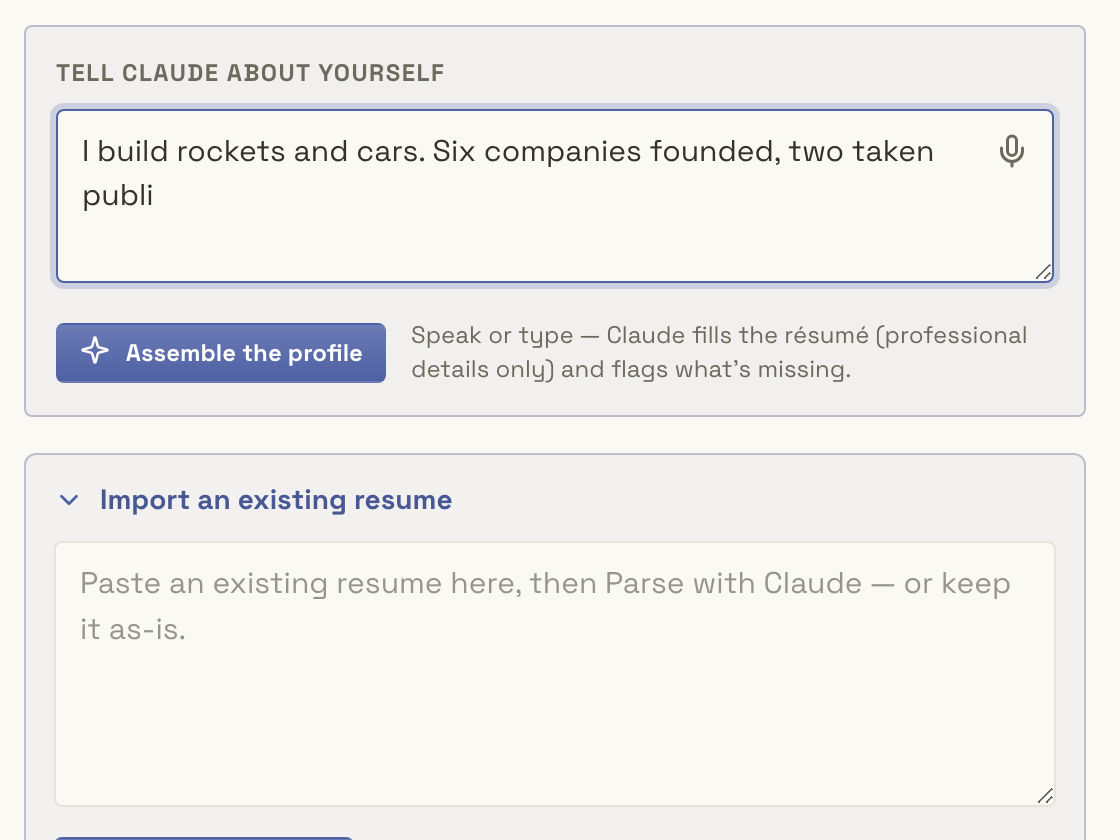
Speak or type, in your own words. No twenty-field form: the agent asks for a story and turns it into a résumé.

Contact, headline, experience, skills, all filled in from what you just said. Every field stays yours to edit.
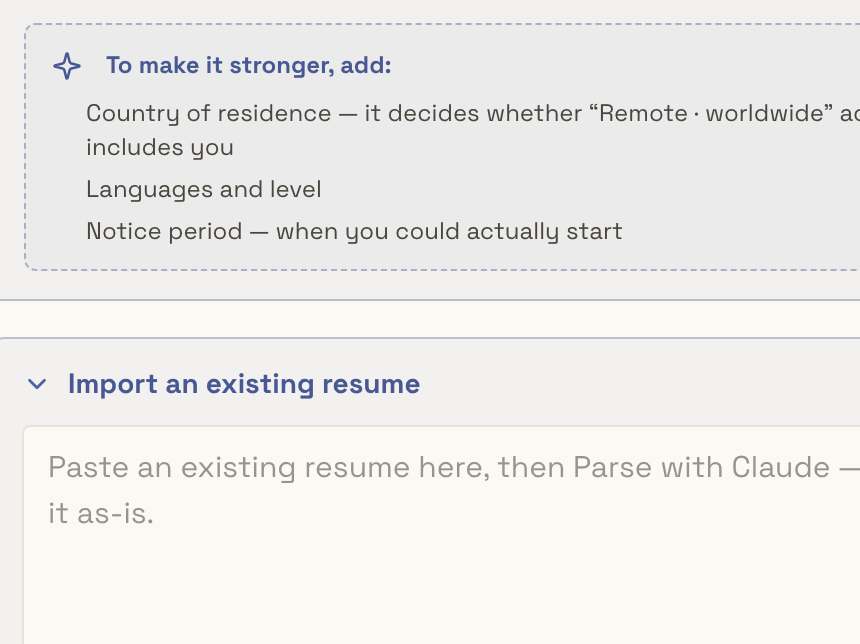
Country of residence, languages, notice period. It says the gaps out loud instead of leaving them quietly blank, because each one changes what the search can find.
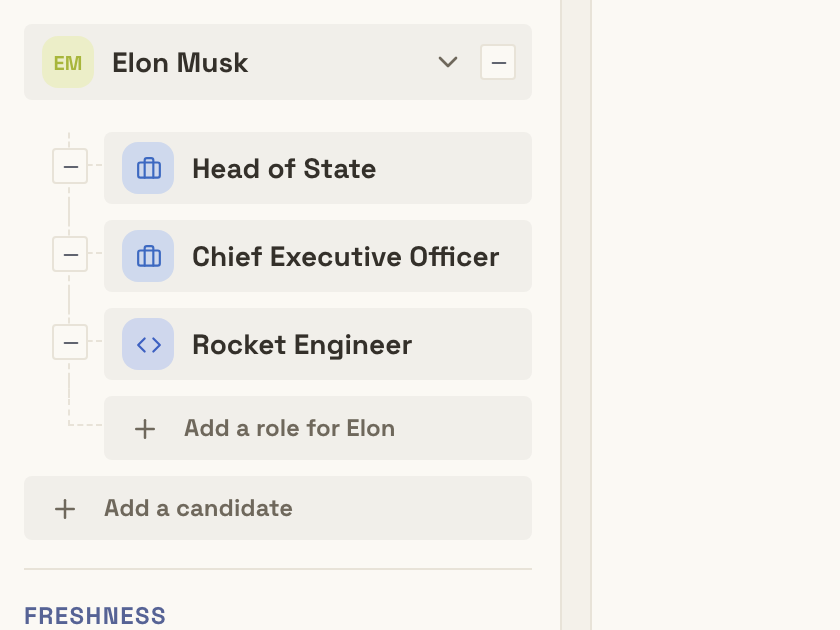
Roles branch off the candidate, taken from their résumé. Plus adds one, minus takes it out of the hunt without deleting anything.
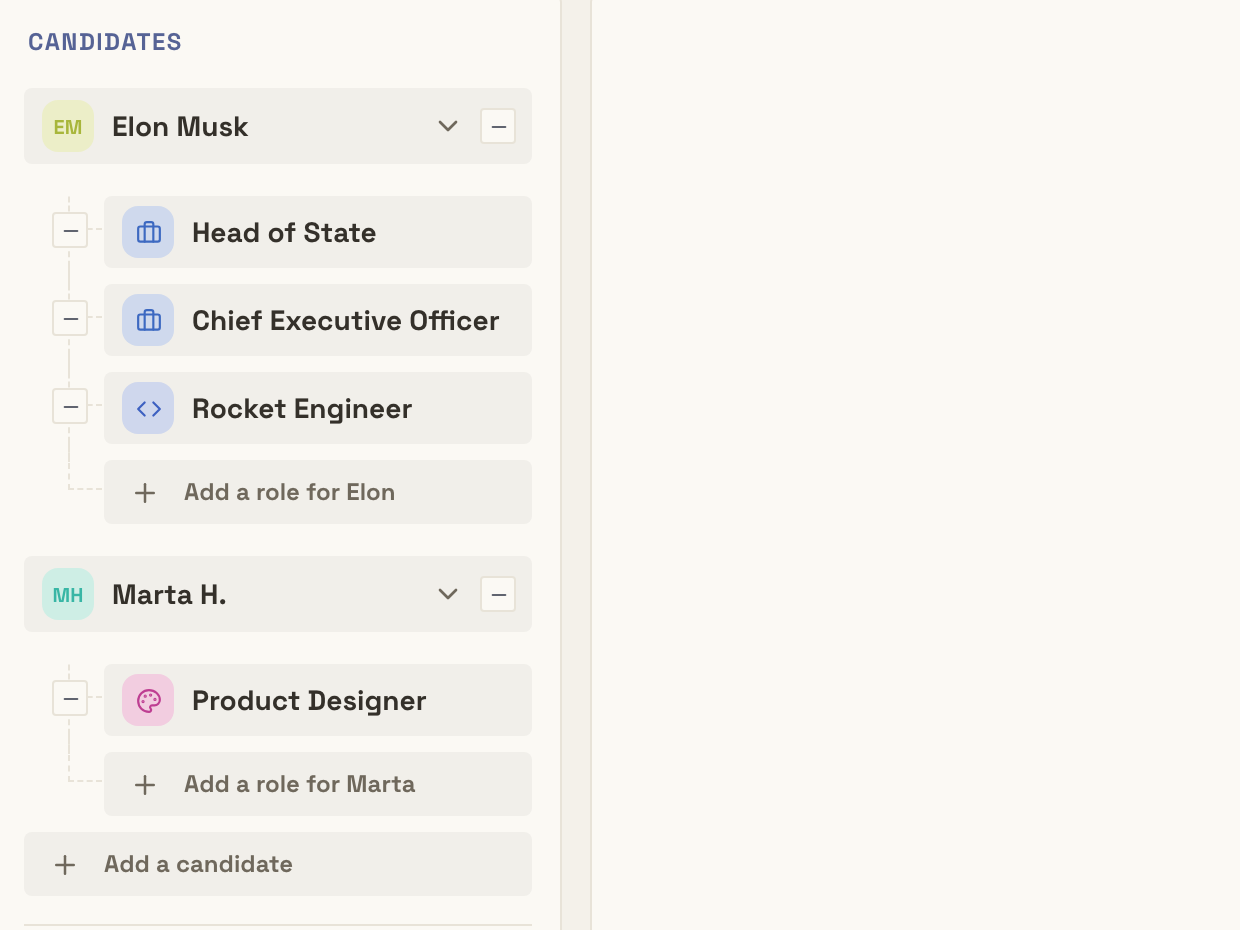
Add a second candidate and the rail groups by owner: a partner, a team, or an agency’s whole bench on one board.
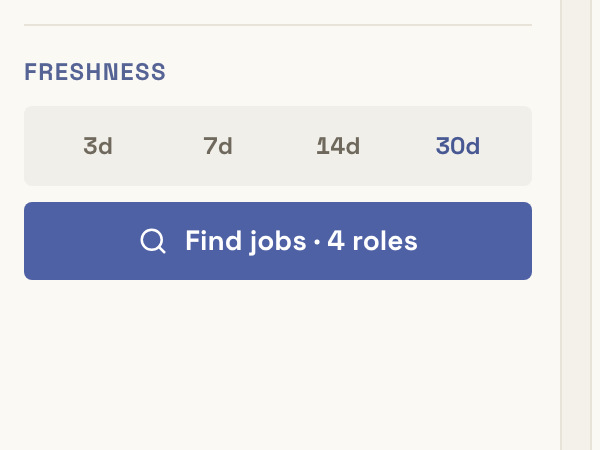
Pick the window (3, 7, 14 or 30 days) and one button runs every role at once.
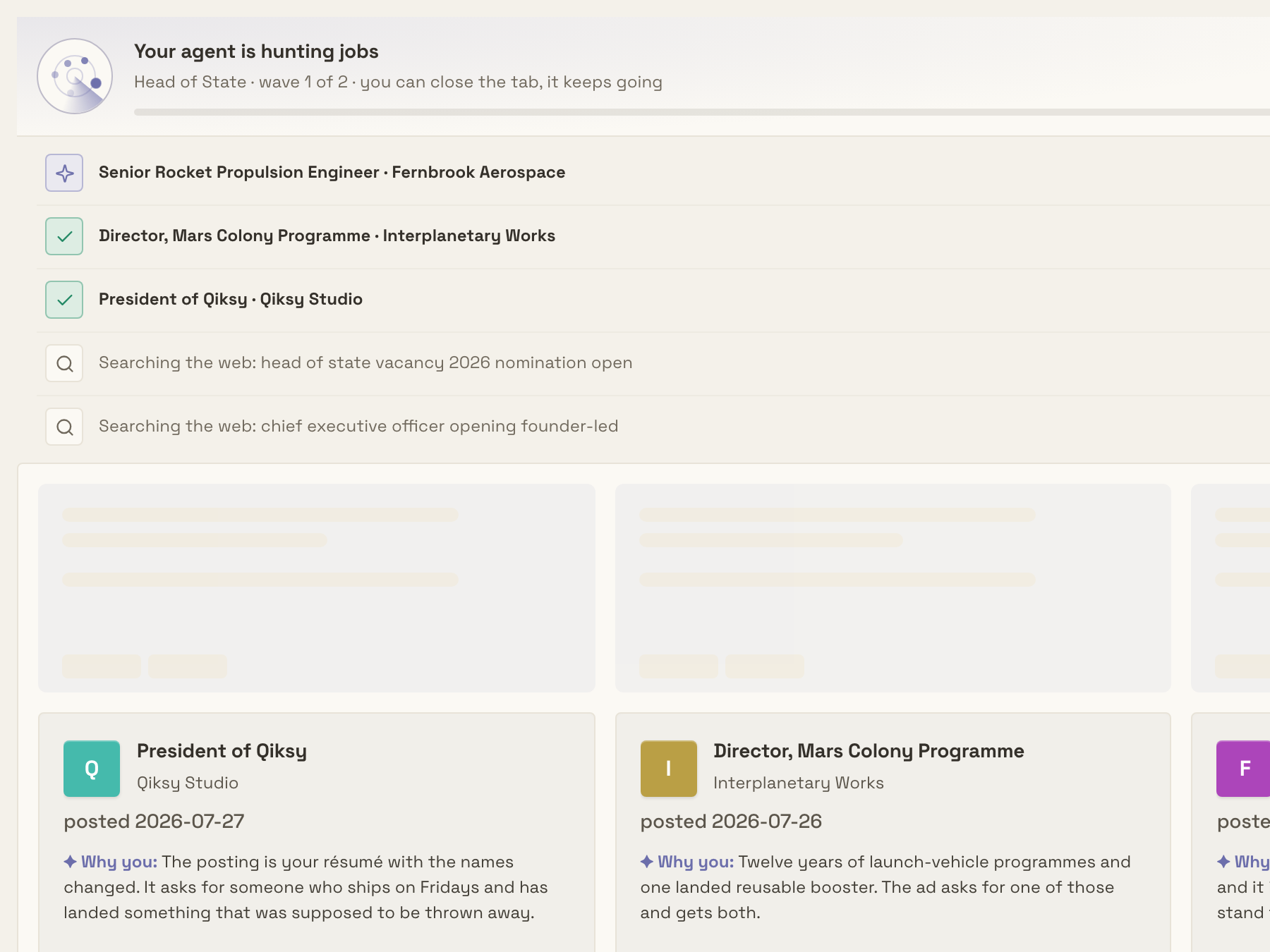
Radar, live log, progress. You can close the tab: the run keeps going on your own machine, on your own Claude.
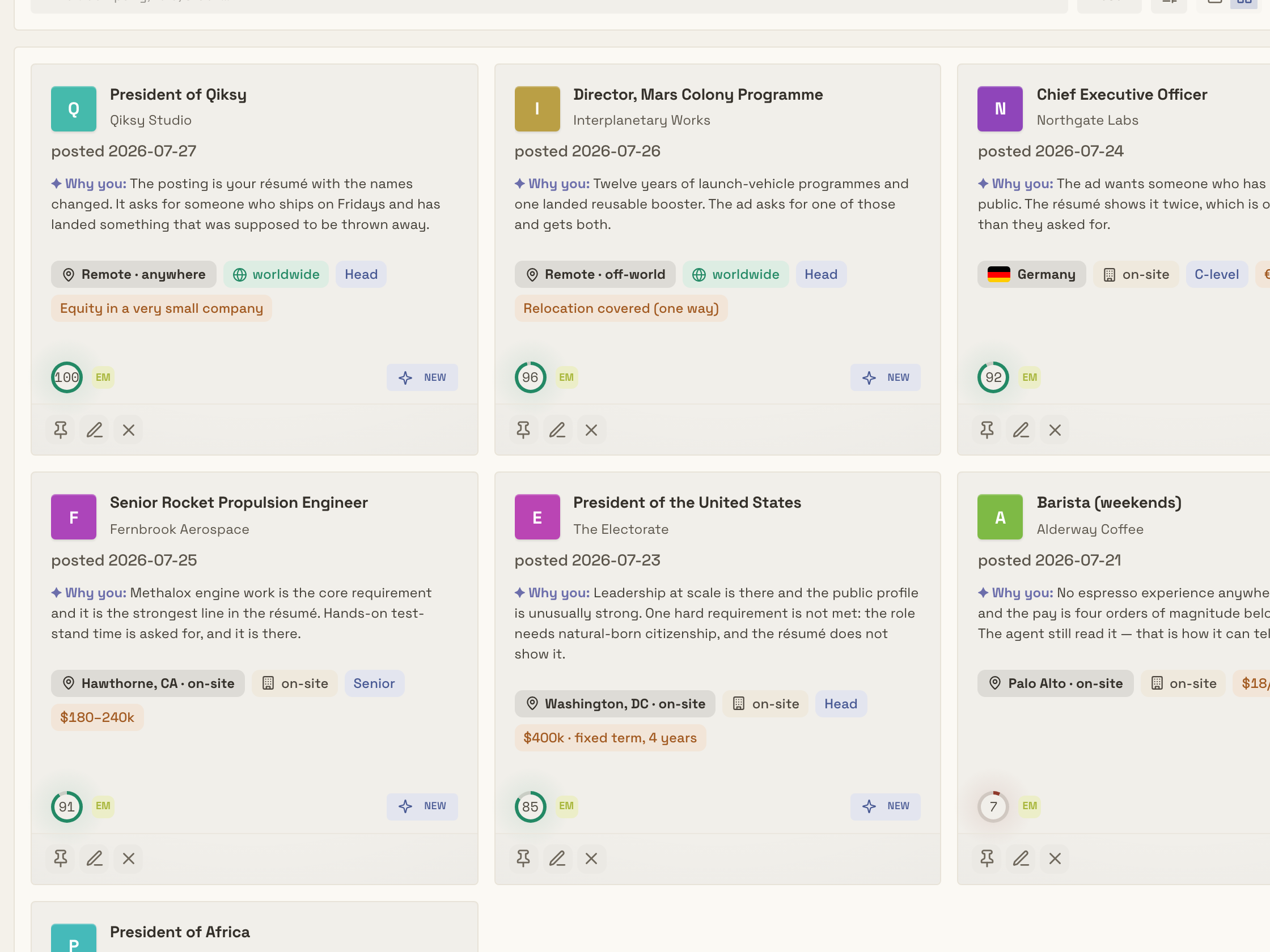
Findings land one at a time, best match first. Tiles or rows, your call.
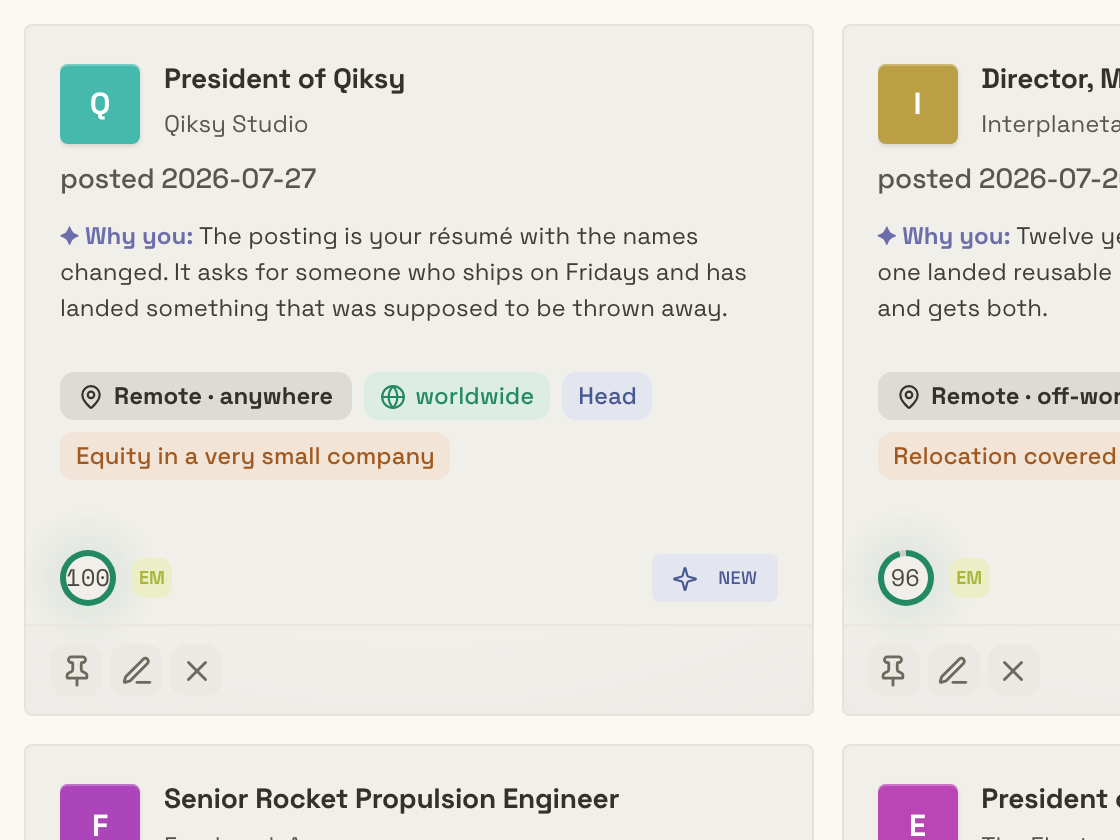
The score, why it fits you, the terms. Under every card: pin it, leave a note, or archive it, and archived is never gone.
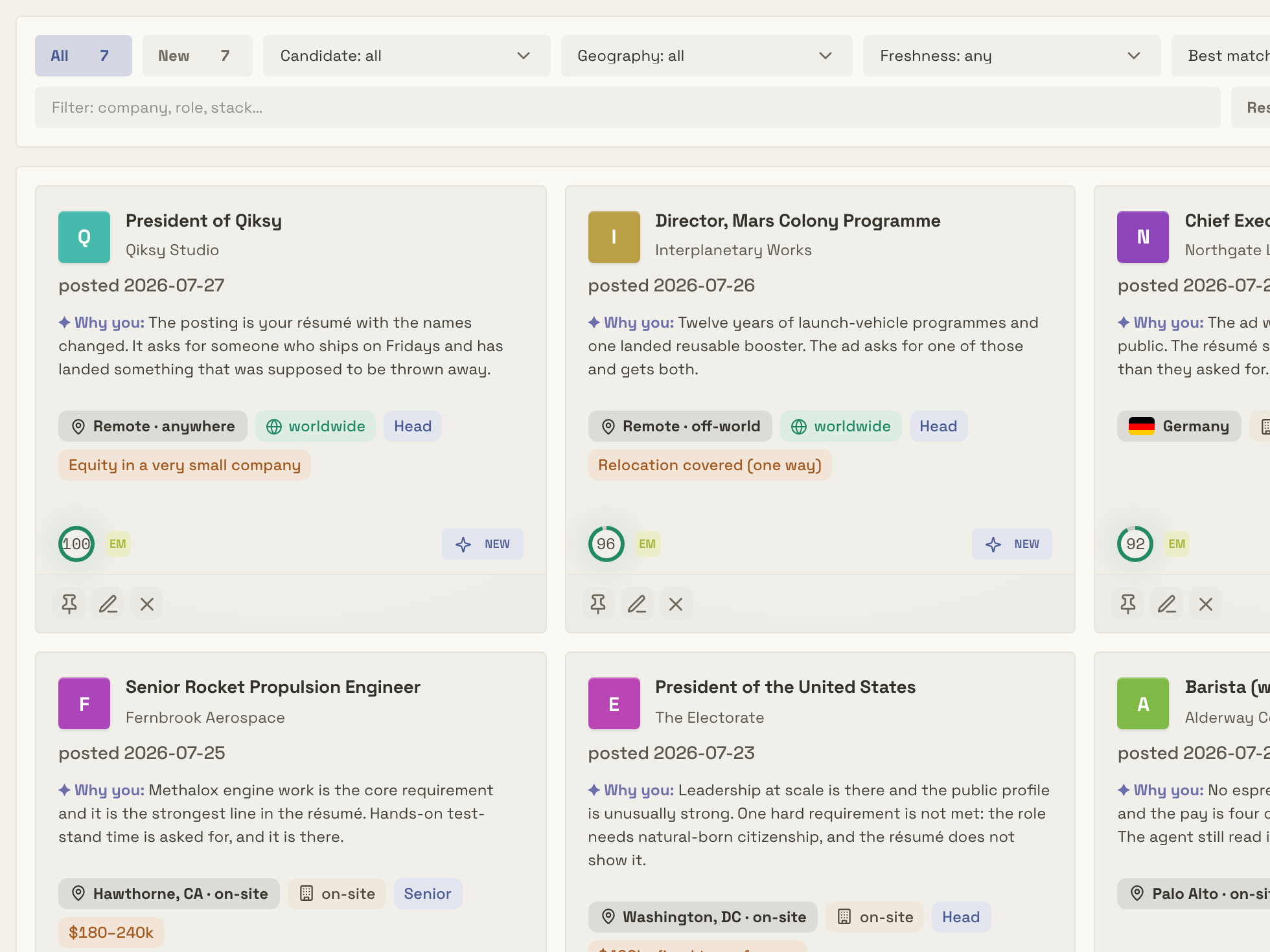
Status tabs across the top, then candidate, geography, freshness and a text filter over everything.
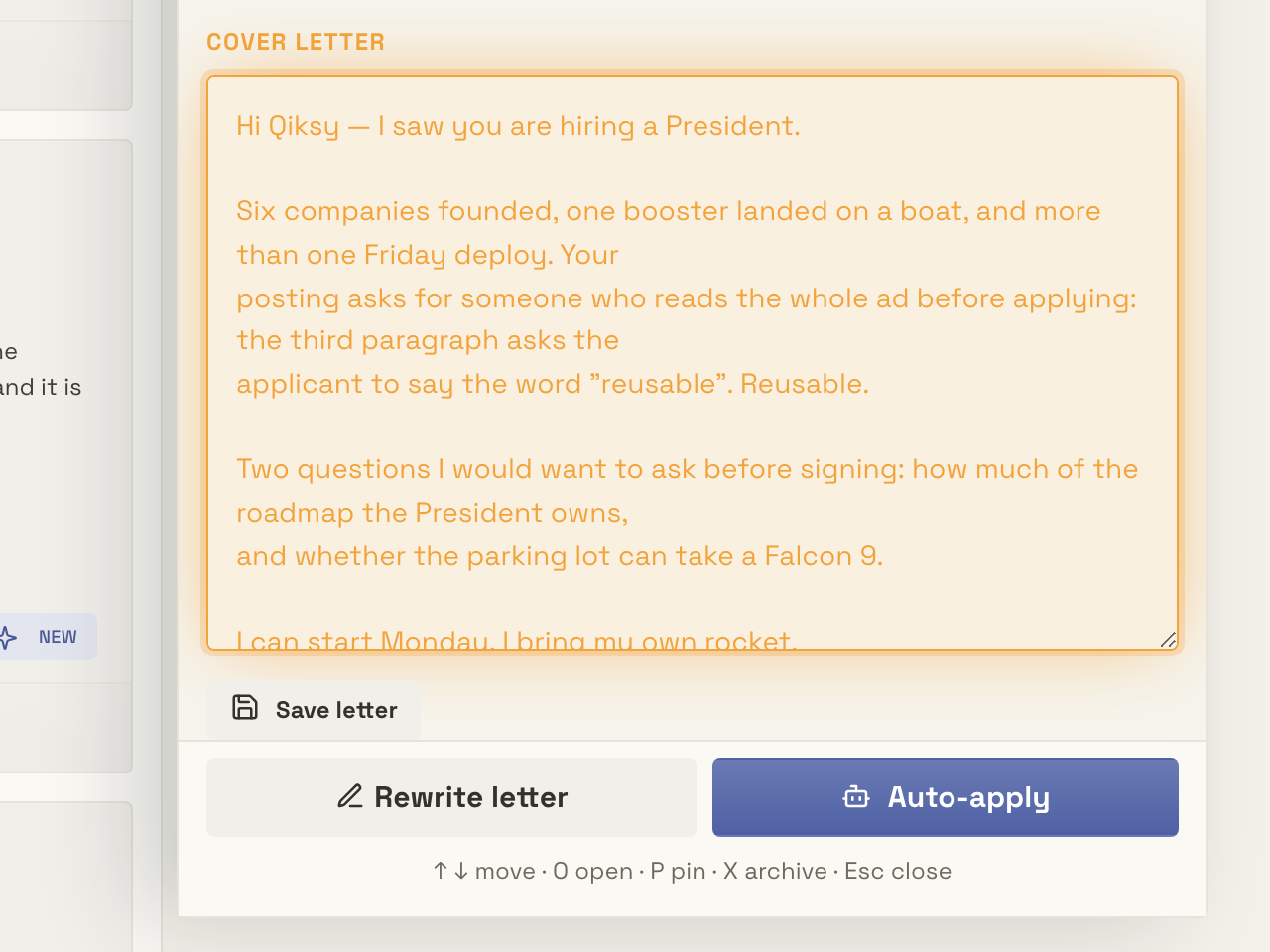
Open a card and the agent drafts against that posting’s own wording and requirements. It fills the form and stops before sending, so you press send.
Candidates, résumés, everything the agents find and every letter they draft are written to one file on your own disk. There is no account, no sync, and no cloud of ours holding a copy. We could not read your data if we wanted to.
The whole database is a file in your own home folder. Nothing is uploaded anywhere: the agents run on your computer, on your own Claude sign-in.
Settings → Your data → Export saves that file. On the new machine, Import brings it back, either merged with what is already there or replacing it. You carry the file; it never passes through us.
We hold no copy, so there is no account of yours to breach and no “delete my data” form to fill in. Removing the tool removes the data with it.
The one consequence to know: since we keep no copy, a new computer starts empty until you bring the file across. Your licence key is not in that file; it stays in your purchase e-mail.
The full search is the same on every plan; you pay for automation and scale.
one price worldwide · yearly, no auto-renewal · runs on your own Claude
Not this engine, but yours
The interface stays this one. What sits behind it is a different machine: your sources, your job titles in the language of your market, your fields on the card, and your own scale of what counts against a match.
Career pages and ATS (Greenhouse, Lever, Ashby), plus global boards and hiring threads. Twenty-six roles in one vocabulary, scored on stack, seniority and how real the «remote» in the ad actually is.
None of the above. Public employment services in 25 countries, sector boards in 27, large care operators in 13, diploma-recognition programmes in 14. Searched as Pflegefachkraft, pielęgniarka, infermiere (117 titles localised into 25 languages) and scored on recognition, language level, visa, employer housing and shift pattern: twelve fields an IT posting simply does not have.
Two industries, one interface, two different machines underneath, down to the scoring, which shares not a single coefficient between them. That is what «one more industry» really costs, and we have paid it once already. It is an assembly, not a switch in the settings.
Where the work in your field actually gets posted: employment services, sector boards, the employers themselves, agencies, specialist programmes. Not «we search the internet», but a list you can read and correct.
Your job titles, grouped the way your field groups them, and translated into the language of every market you hunt in, because the English term leads to aggregators, not to vacancies.
What the agent is required to find out about every opening: the things your decision actually turns on. In care that is diploma recognition and housing; yours will be your own, and we write them down at the discovery.
Your match scale and your deductions: what lowers a score and by how much. Every deduction is shown as a line a human can argue with («−25 · on-site only») instead of hiding inside a final number.
The cuts your market is really sorted by: countries, administrative regions under their local names, freshness, statuses, whatever you filter on when you work.
Letters written from the résumé, application forms filled in your own browser up to the send button, monitoring that watches for new openings, and an export of the whole database.
A general-purpose tool has to fit everyone. That is its condition, not its flaw: it searches where searching is the same for everyone, asks what makes sense for everyone, and scores on what everyone has. An engine built for one field carries no such condition. It goes to the addresses that are real in that field and names them one by one. It searches with the word the profession is called by locally, not with a translation from English. And it finds out what the deal actually turns on there, which a general tool has nowhere to put, because it has no field for it. What we do not claim: that we will find what is not in open sources, or that another tool will find less. What we do claim is that where your field has to be looked at, ours looks, because it is written down rather than guessed.
How this actually works. We start with a paid discovery: your field, your sources and the signals you select on, written down, and the quote comes from that document, so you see the price and the timeline before the work starts, not after. The build then goes module by module at a fixed price each, not by the hour: anything not in the discovery is a separate line, not a surprise. After that, support under contract, because sources change and someone has to watch them. Inference runs on your own Claude subscription: there is no usage bill from us. What we will not do is name a timeline before the discovery. And if your field sits close to one already open, we will say so, because opening it as a vertical inside this tool is cheaper than building a separate system.
Discuss a buildMore from Qiksy Studio
Add a candidate, run it on the Claude already on your machine, and the market comes to you: matched roles, ready letters, one clean pipeline that keeps watching for new openings. First candidate is free.
Start your job huntFree to start · nothing leaves your browser · runs on your Claude sign-in
We're building Qiksy in the open: new tools, real progress, the occasional stumble. Get the short note when something ships.