For writing the spec from what is really there
Every field of the screen captured into a table, ready to paste. Test and production compared field by field. No screenshots pasted into a document one at a time.
See the panelsThe application opens inside it, already signed in. One press turns the screen into a table of fields: label, control, required, validations. Two environments, compared line by line.
$79/yr locked for good · first hundredOne email, when it ships. Nothing else.
Every field of the screen captured into a table, ready to paste. Test and production compared field by field. No screenshots pasted into a document one at a time.
See the panelsjig.open("/checkout")
jig.login("admin")
jig.fill(form → 96)
jig.read("network")
Connect Cursor, VS Code or Claude Code over MCP. Your agent writes the code; here it opens the page, signs in as a role and presses the buttons.
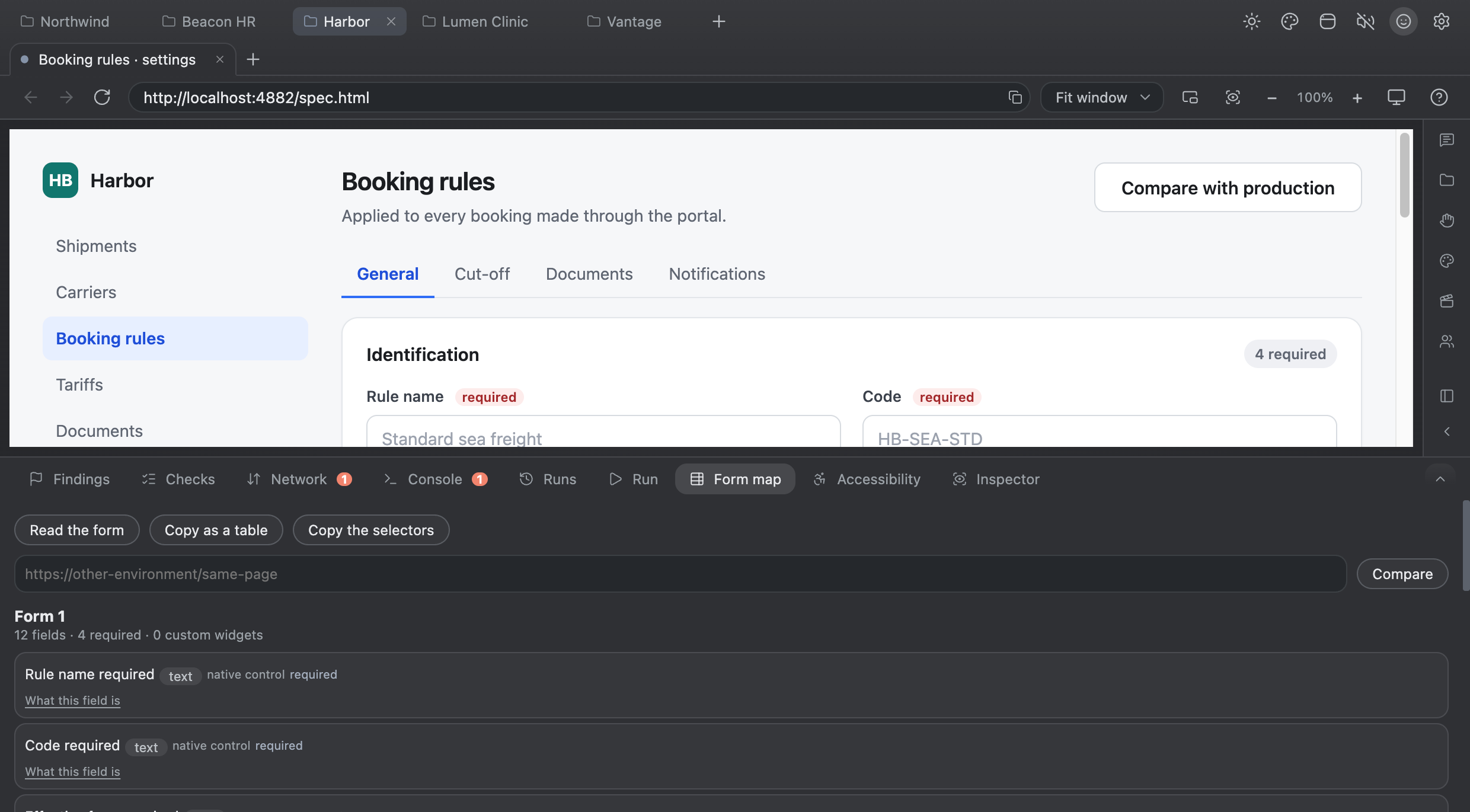
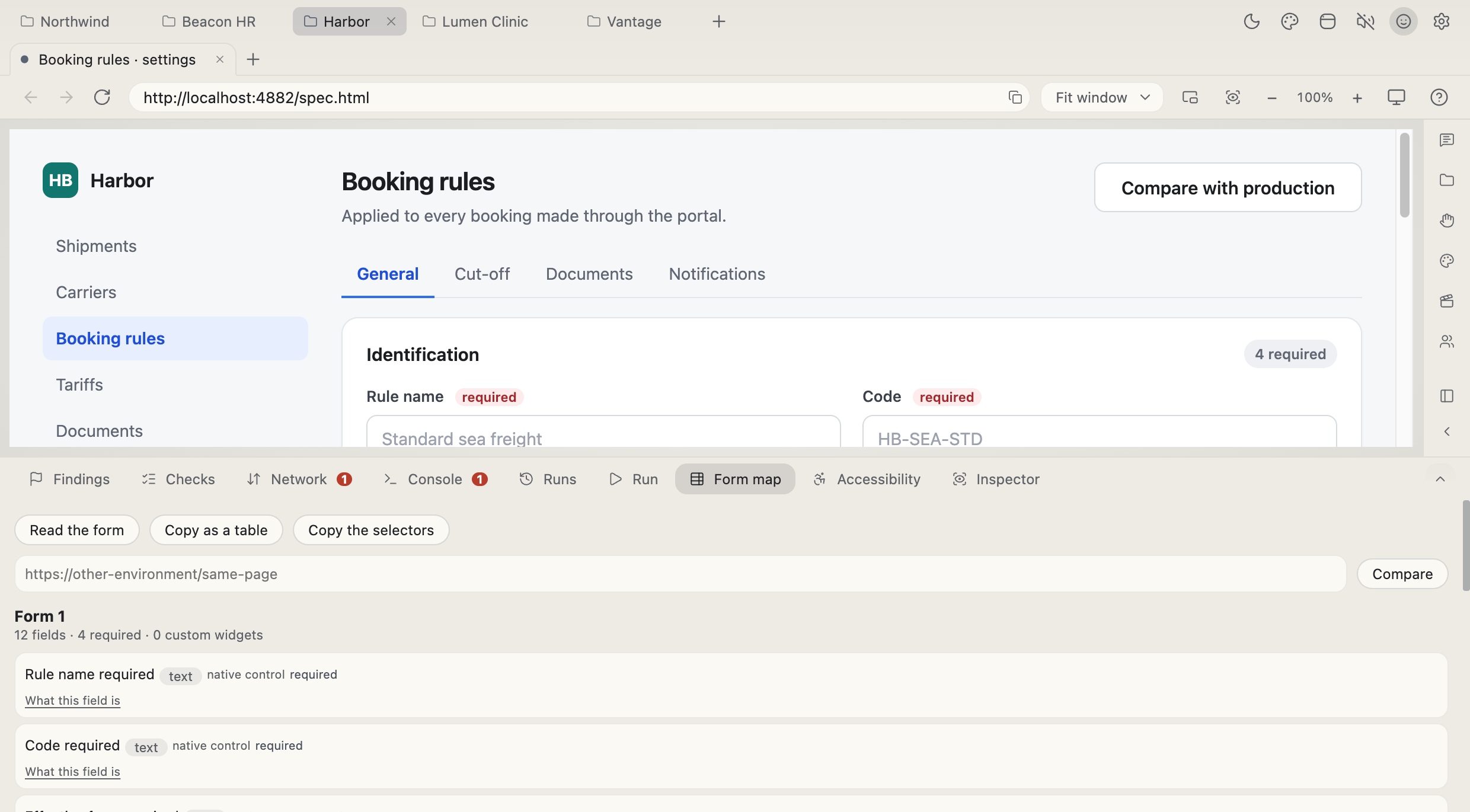
Connect your editorWriting requirements starts with reading a screen, and reading a screen by hand takes a day. In Jig the application opens inside the window, already signed in. One press turns the whole screen into a table of fields: the label, the control, whether it is required, the validations, the reference values. Ready to paste into the specification. Open the same screen on test and on production, and it tells you field by field what differs. No screenshots pasted in one at a time. No asking a developer which fields are required. Jig, the browser that reads the screen back to you.
For QA and for whoever ships the code · macOS, signed and notarised · Windows, not signed yet · everything it measures runs on your machine
Pick a panel, the same way you would inside Jig. The first two are the ones you will live in.
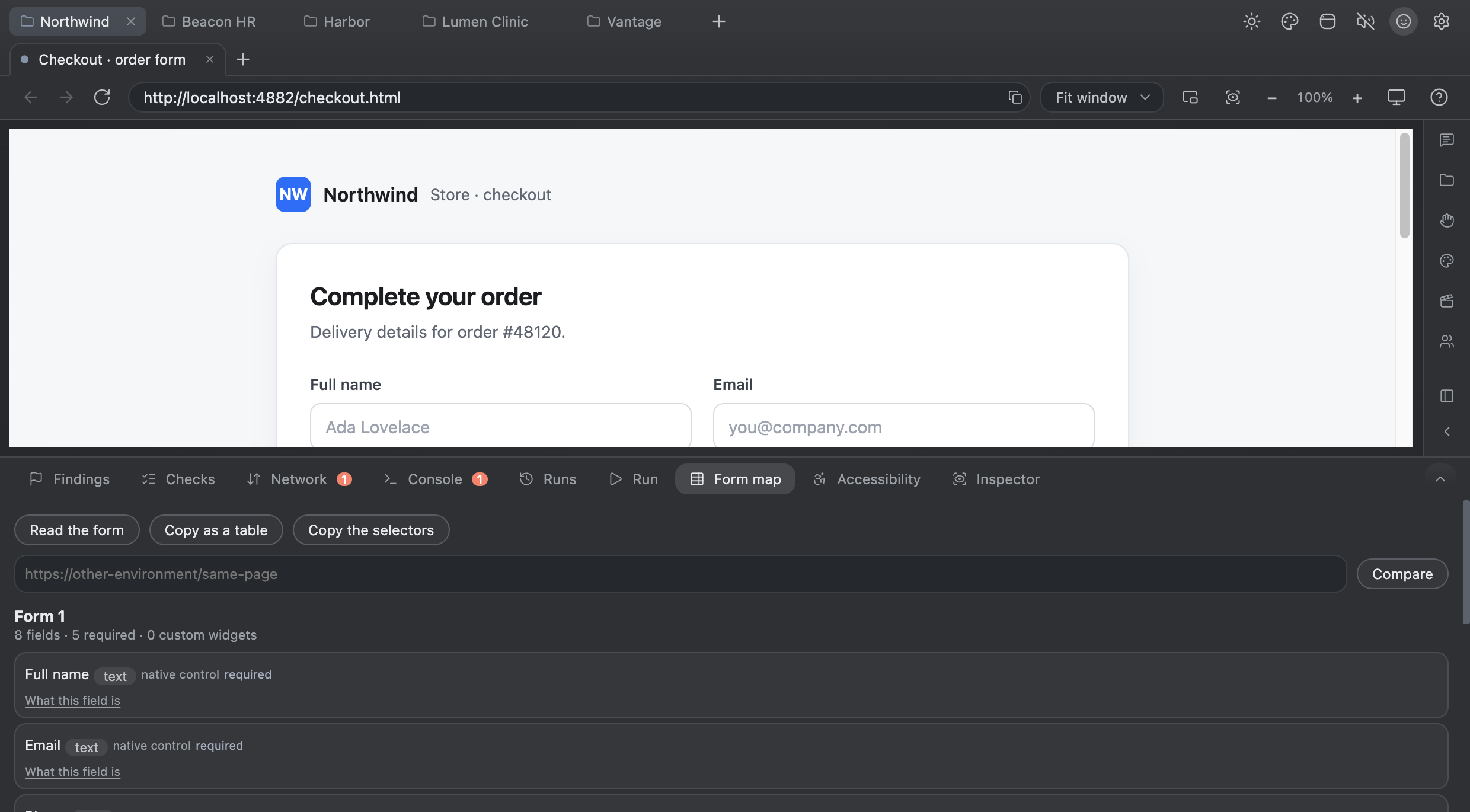
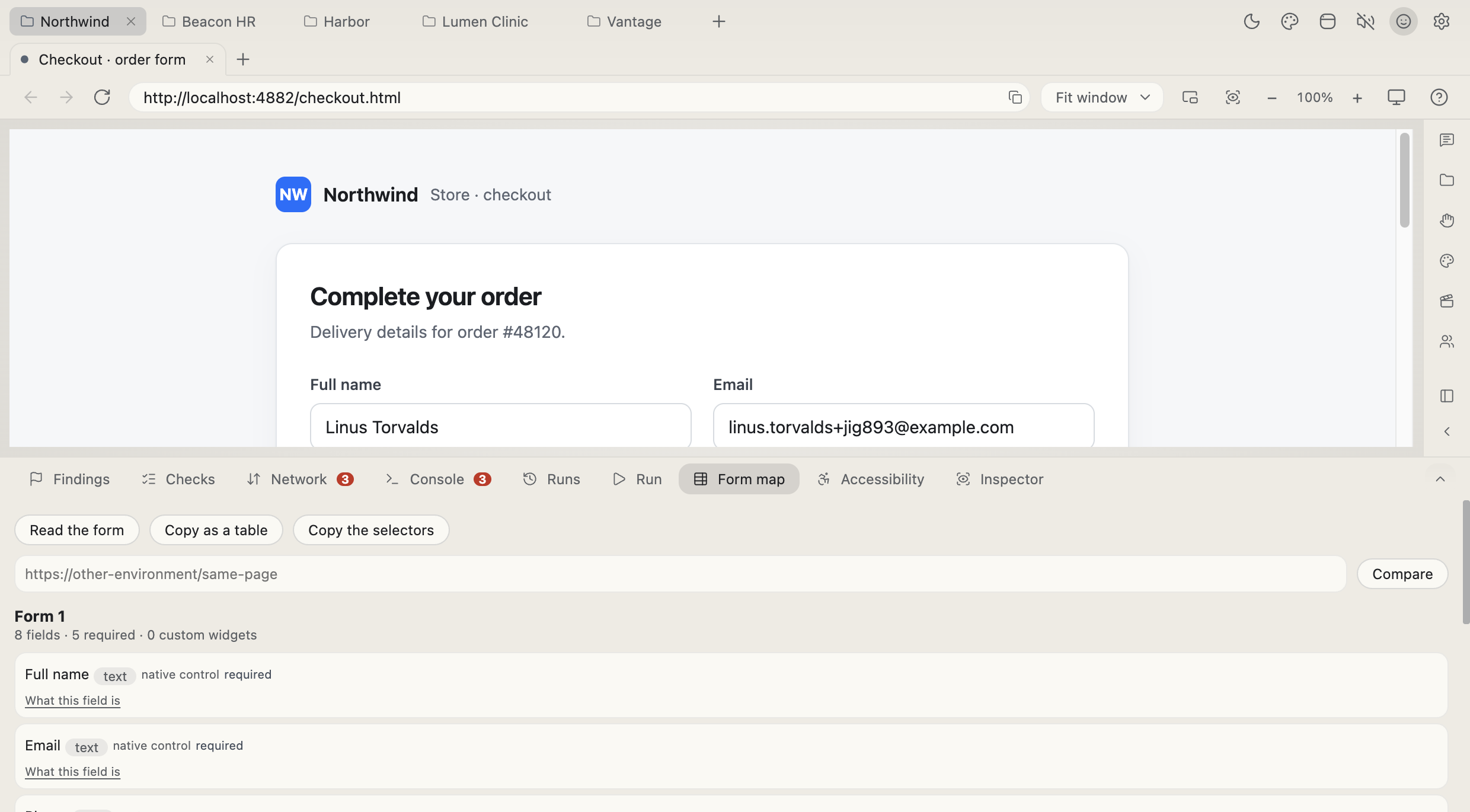
Every field of the page in one pass, with its kind, whether it is required and how the widget has to be driven, without a single click.
Nothing here is impossible without Jig. That is the point. It is possible, and it costs a day: open the screen, type its fields into a table, ask a developer which of them are required, and paste the screenshots in one at a time.
An IDE is built for the person who writes the code, and every attempt to bolt manual testing onto one ends the same way: a plugin that opens a preview and can tell you nothing about it. Jig starts from the other end: the application is the document, and everything around it is for reading that application rather than editing it. Keep your editor; connect it, and the agent in it gets hands here.
Five applications open at once and you tell them apart before reading a word: green is staging, red is the production copy nobody may touch. The tint travels with the project: open it on another machine and it looks the same.
It writes the endpoint, writes the form, and then describes to you what to click, because a coding agent has no browser with your logins in it. Connect your editor to Jig and it stops describing: it opens the page, signs in as one of the project’s roles, fills the form in one pass and reads what the server actually answered.
{ "mcpServers": { "jig": {
  "command": "npx", "args": ["-y", "jig-mcp"] } } }
There is no key in the snippet. Jig writes its address to a file only you can read, and the client picks it up there, so a restart on a different port needs nothing re-pasted.
Which project it lands in is decided by the folder your editor is open in; several editors connect at once and none of them moves your window. It is refused for exactly the same reasons the chat here is refused: connecting an editor grants nothing that was not already granted.
The first pass over somebody else’s form costs work: a hand-rolled list of divs has to be pressed, watched, understood: where does the value actually land. Jig does that once and writes it down: a procedure per control, plus a whole layer for the form (the order fields take values in, the knots, the places that fought back). From the second pass on it is not analysis any more, it is a read from disk.
The same three rings Jig shows in its settings, after a week on an internal admin panel.
Everything worked out here stays with you and runs with no network. The key is the place plus the markup, so the same application is recognised from any of your projects, and a stranger’s site inherits nothing.
Several machines under one key: what a colleague worked out on your internal admin arrives by itself. Encrypted before it leaves, with a key derived from your licence.
The first Jig in the world to meet an unknown widget pays for taking it apart. Everyone after gets the procedure instantly and free, with no key at all. What travels is a hash and the procedure: no address, no page, no values.
A developer adds a field or drops a wizard step: different shape, same address. Jig recognises the form by its place, carries what still applies onto the new structure, and says what changed.
Ant Design, MUI, Vuetify, PrimeReact, Kendo, Mantine, web components: built into the engine, working from the first minute. Memory is for where your own begins: the internal panel built out of divs.
96% of fields filled with no memory and no model, measured across forty pages of forms
The screen taken apart into fields (label, control, required, validation, reference values), with the difference against production stated in the same breath. Ready to paste into the specification.
POST /api/orders → 200  REF-48121
POST /api/orders → 200  REF-48122   ← the same order, twice
The browser, the inspector, the form map, the fill, the mocks, the recorder, the audit, the network log: none of it goes anywhere. When you hand a task to Claude, what travels with the question is the shape of the work: the field names of the page, the names of your roles, your checklist and the titles of your findings. What you type stays here, and so do passwords, account logins and the addresses of your stands. A screenshot only ever leaves if you switch that on yourself.
Jig never acts in a tab you are signed into yourself. It works in its own, and the login it uses is the one you gave it. And it only ever opens the sites you allowed for this project; anything else is refused, whatever the task says.
The same report also comes out as CSV, one row per item with its state in words, so it opens in a spreadsheet and joins whatever else you keep there. The HTML one is what you attach when somebody asks for the conclusion rather than the data.
Self-contained: the screenshots are inside it, so it opens on somebody else’s machine with nothing attached. It names what passed, what failed, what was blocked, and how many items nobody opened at all.
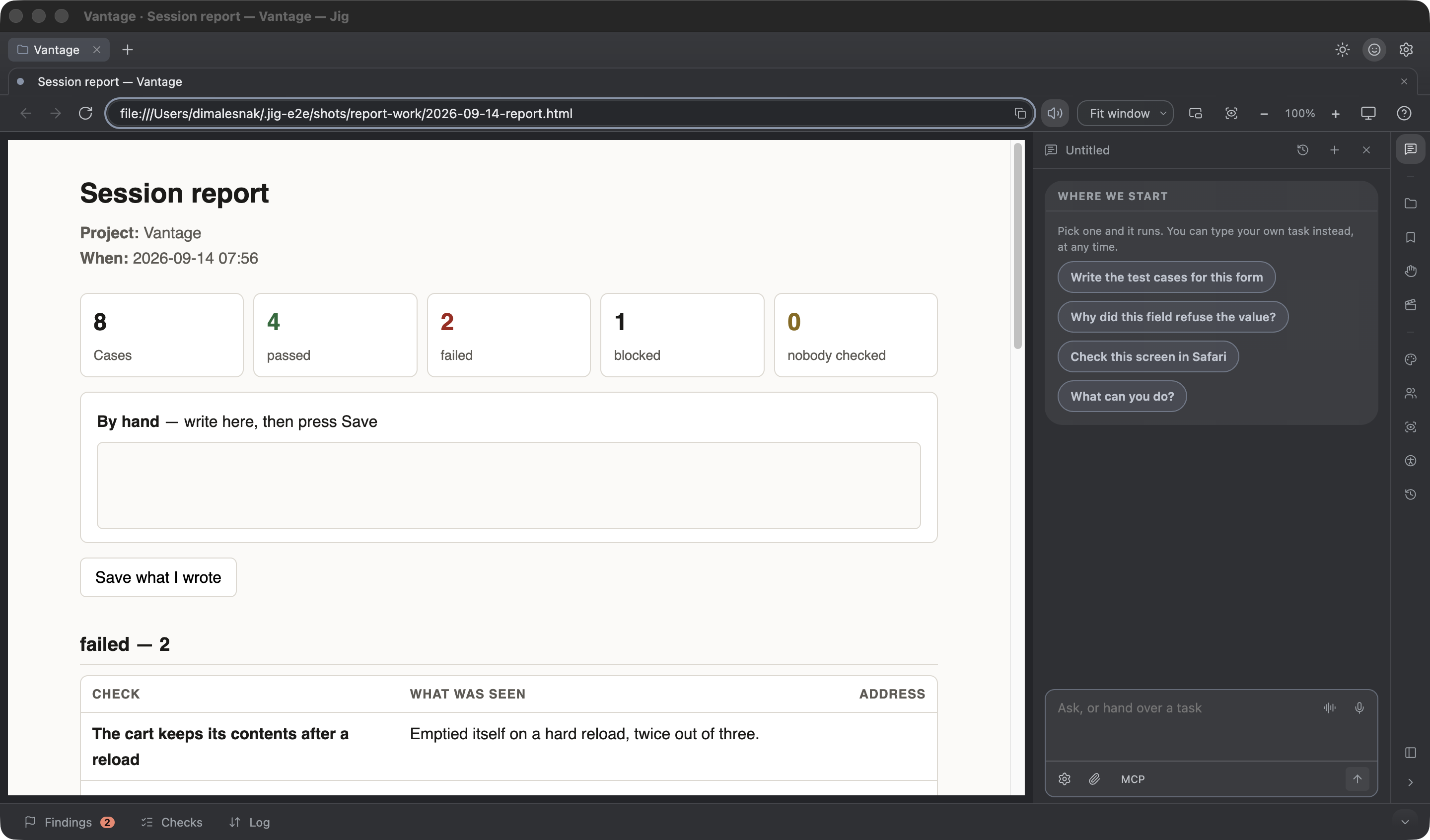
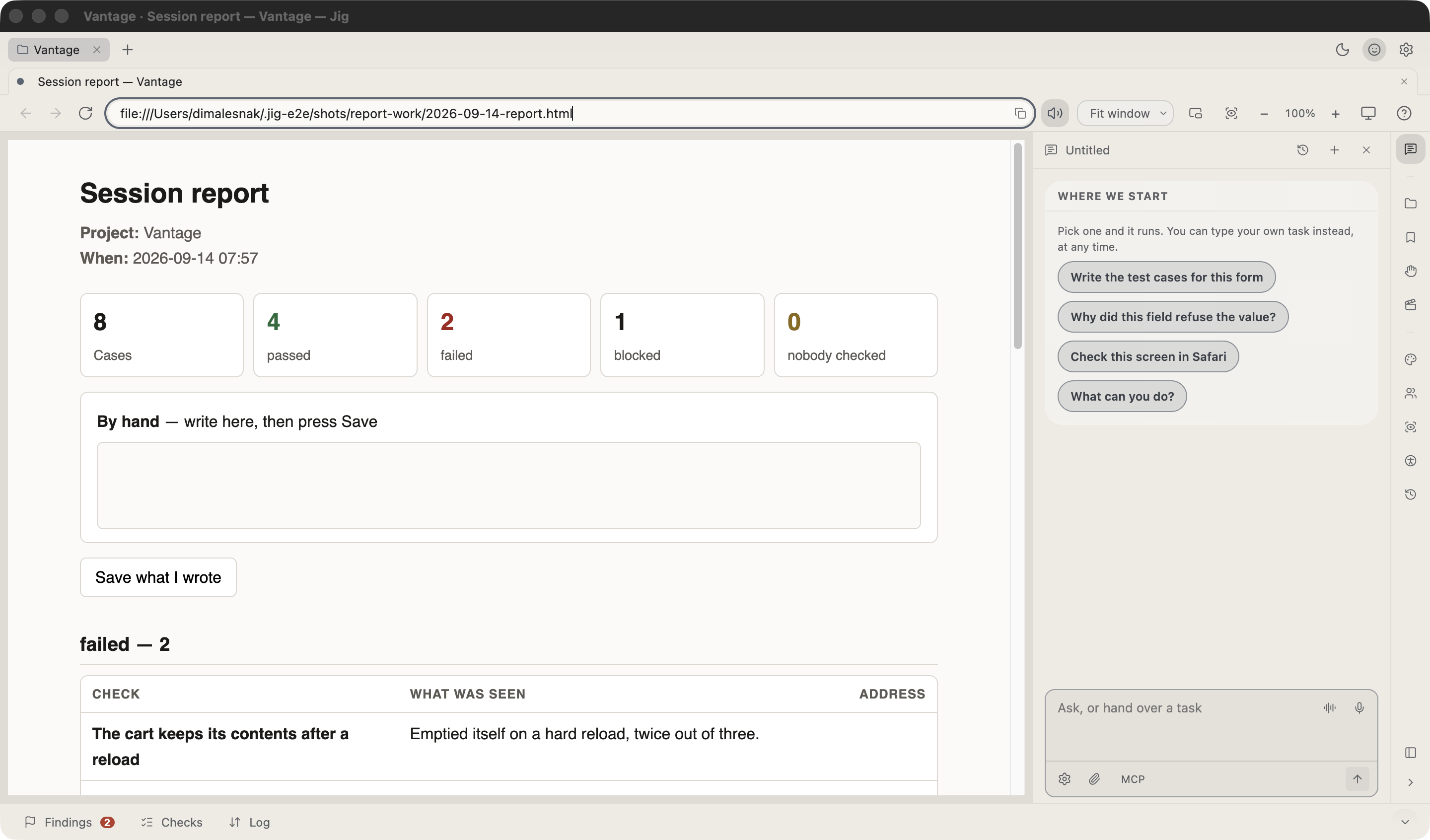
Numbers say what happened; what it means for the release is known only to the person who looked. Write that into the report itself. The text lives in a markdown file beside it, so it survives every rebuild.
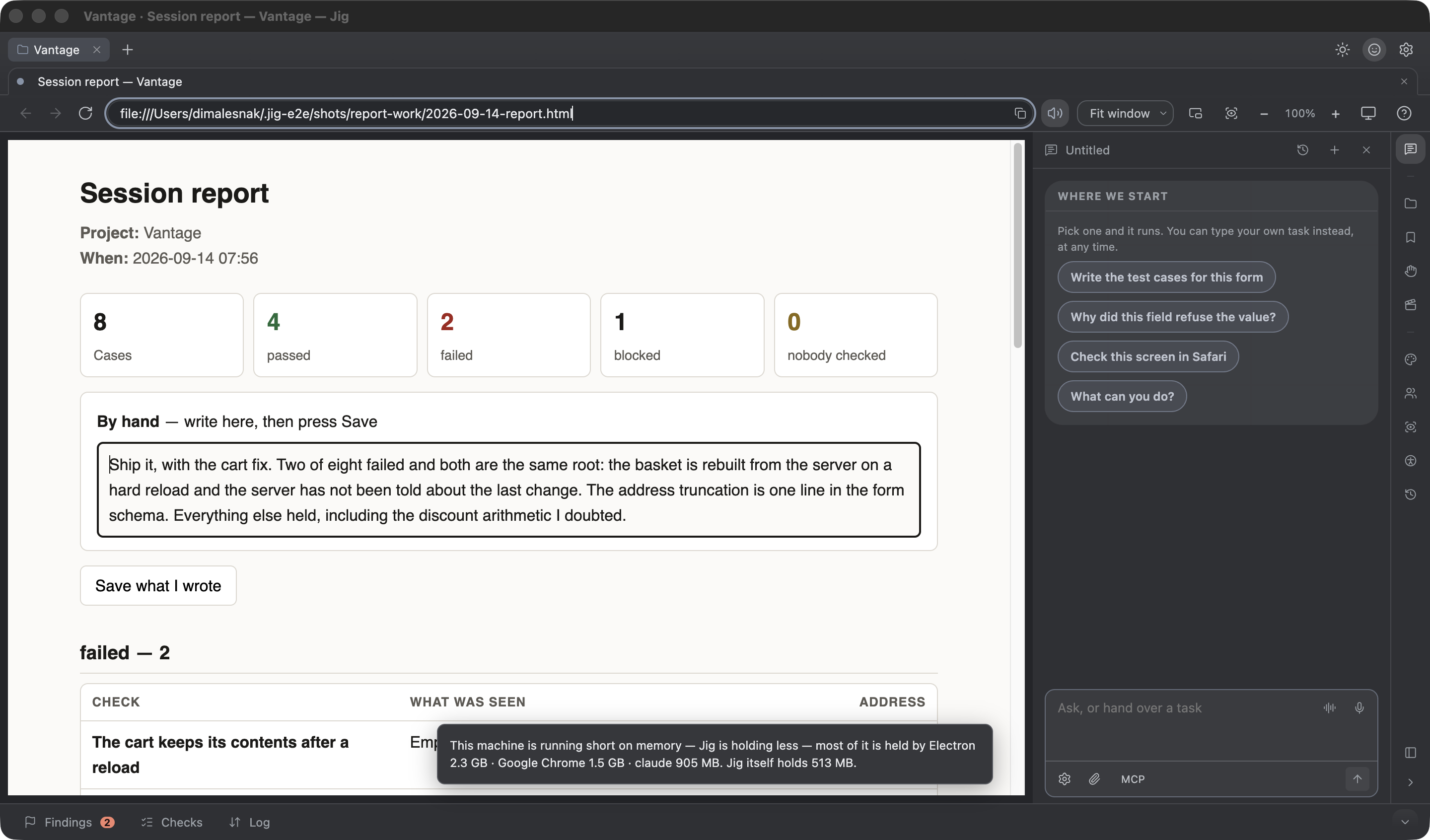
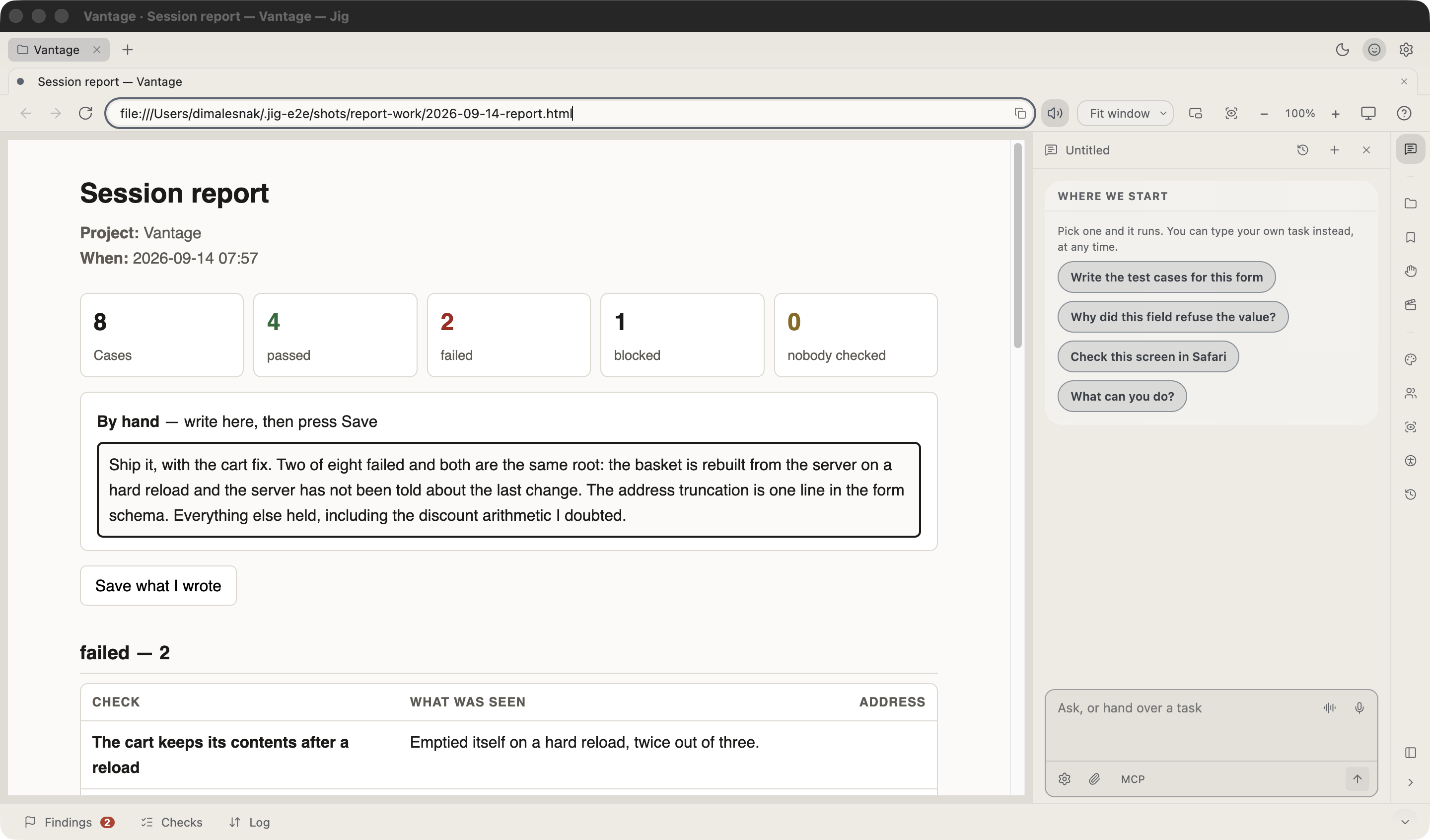
Printed by Jig rather than by the browser, so headings and tables arrive as headings and tables. A screen reader walks the document instead of meeting a picture of one.
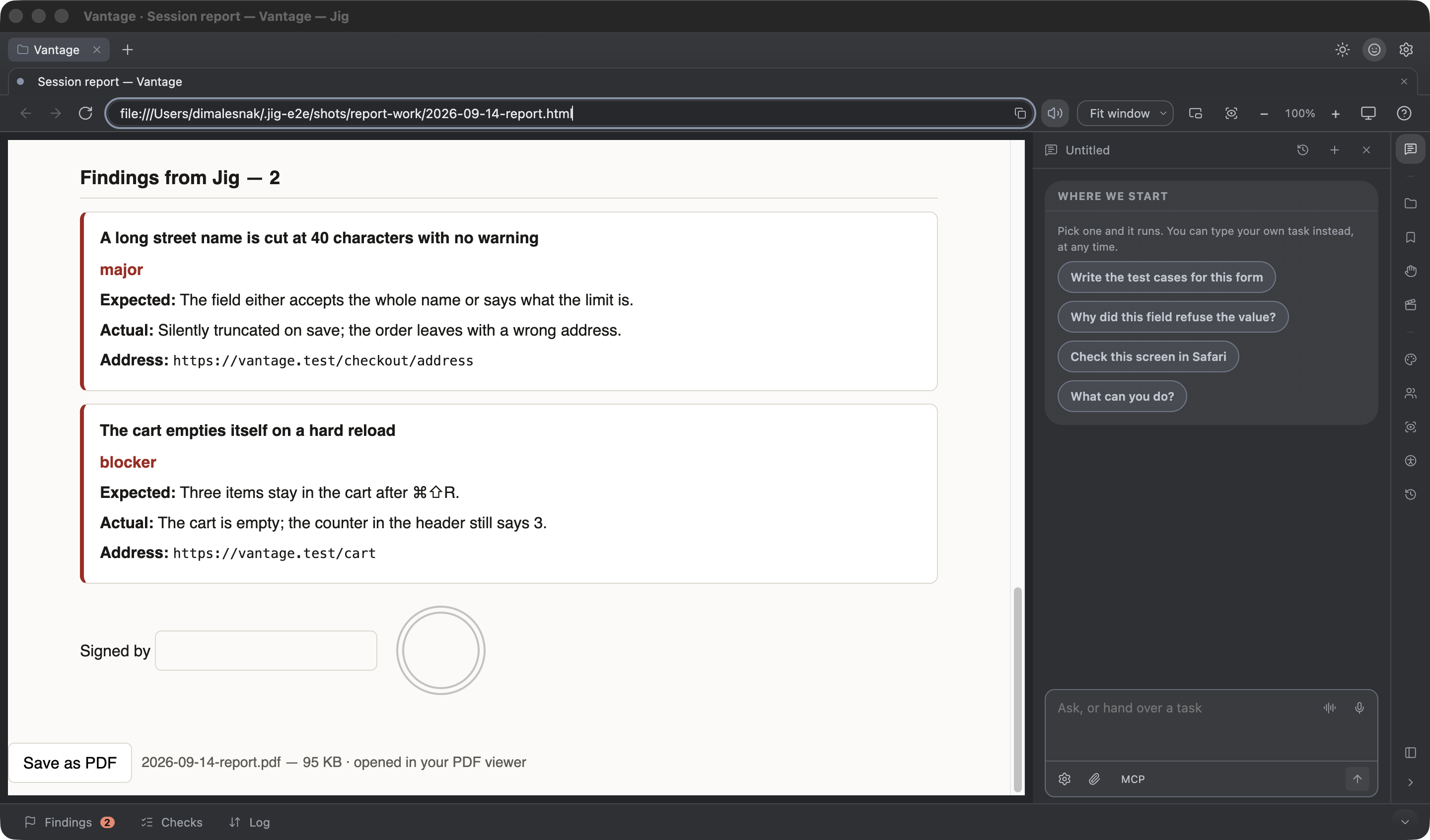
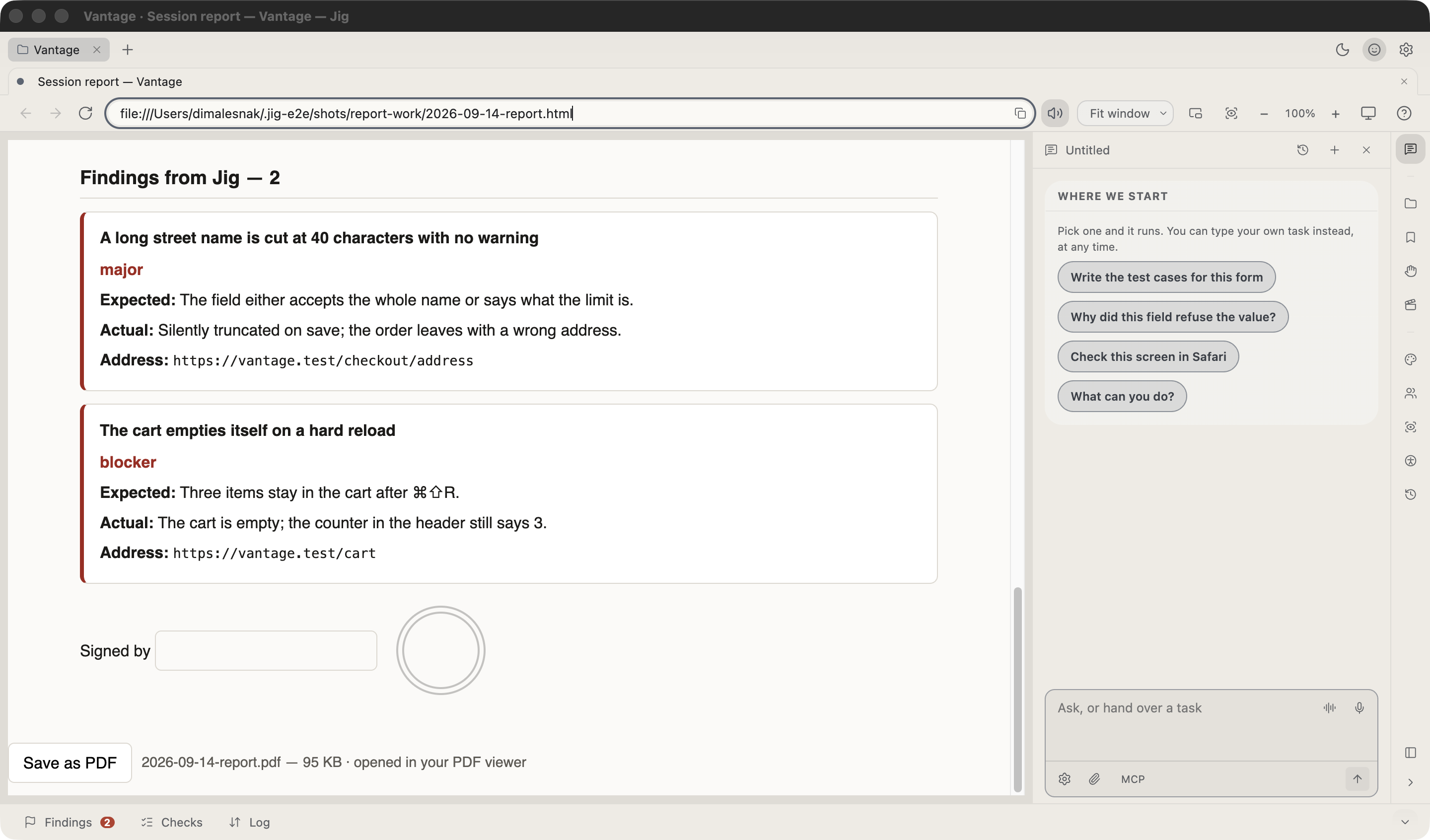
The first run of anything is free, always. What you pay for is the second one, because the repeat is where a professional’s time actually goes.
Three seconds in Jig against seventy-three with a Playwright script, and the script had to be written first. Here nobody wrote one.
$0 forever
No account needed
$99 / year, per person
One payment. Nothing renews itself: our till does not keep your card.
$149 / year, per seat
Invoice from a registered business, with the documents your finance department asks for. Seats can be reassigned.
$79 / year, fixed for good
The first hundred people to buy keep this price for every year they stay, including after the public price goes up.
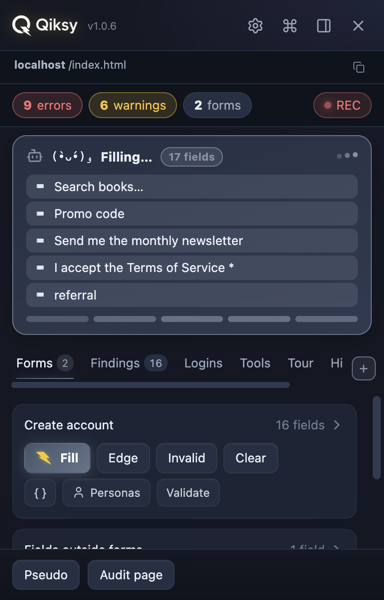
 Qiksy BridgeChrome extension · already on the Web Store · $49 / year on its own
The same key unlocks Qiksy Bridge Pro, our Chrome extension for testing inside the browser you already use. One purchase, both halves of the trade: the browser for the work you plan, the extension for the page you happen to be on.
It rides along in the browser you already have open: your profile, your logins, the tab in front of you. It fills the form, catches the console error, the failed request with the server’s own body and the accessibility violation, and hands the lot back as one file you attach to the ticket. Nothing to script, no second browser to sign into.
A regression pass with a name, several signed-in roles at once, the same form filled four ways, a recorded flow replayed on a button, and the difference between last week’s run and this one. This is the half a lead, a QA owner or whoever signs the release off actually needs: something to show, not a feeling.
A developer checking the feature they wrote an hour ago on staging, under their own SSO. Support reproducing what a customer sent. A project manager opening the link in a ticket to see for themselves. Nothing to set up and nothing to plan: it is already in the browser they use all day.
Neither half needs a model to measure. Forms, findings, the network with response bodies, the WCAG audit, the Tab-order walk: local, free, no account and no Claude. A model only enters when you hand the work to an agent, and then it is your own Claude subscription, not tokens resold by us.
So this is not two-for-one. It is one job that happens in two places (the pass you plan, and the page that lands in front of you), and having paid for the larger half, you should not have to buy the smaller one twice. It only runs this way round. A Qiksy Bridge key does not unlock Jig. Jig is the larger tool, and paying for the smaller one cannot buy it.
Full Pro for thirty days. Two weeks is not long enough to meet a regression, and the regression is the thing Pro is for.
The thinking is done by your own Claude subscription, and only by it. Jig finds it on this machine and works through it: unlimited, with nothing extra to pay and nothing counted by us. We have no model service of our own and sell no allowance: the one thing we could charge for here is inference, and inference on your subscription costs us zero. Without Claude on the machine, Jig still measures everything it measures; it simply does not think, and it says so rather than pretending.
Leave an address and we will write once, when Windows lands and sales open, with the founding price attached.
Windows: this installer is not signed yet. The certificate is still in identity validation. Windows will show a blue “Windows protected your PC” screen: choose <b>More info</b>, then <b>Run anyway</b>. It installs into your own user profile and never asks for administrator rights. Tested on a real Windows Server 2022: the build behaves exactly as the Mac one.
Or from the Microsoft Store: signed by Microsoft, no warning screen, and it updates itself.
You are downloading Jig from us directly, not from a store, so both systems say something the first time. Here is exactly what, and which button to press.
The installer puts Jig in your own user folder and never asks for an administrator password.
Windows shows a blue window headed “Windows protected your PC”, and the only button on it says “Don’t run”. Do not stop there. Press the link “More info” first, and a second button appears: “Run anyway”. That is the one you need.
Where that window names the publisher it will say “Unknown publisher”, and that is expected right now: our signing certificate has been bought and is going through the certificate authority’s identity checks. Until it is issued there is nothing to sign the file with. So the name is not what tells you this file is ours. The checksum below does.
The image opens with Jig on the left and a shortcut to Applications on the right: drag the first onto the second, and that is the install.
There are two files, one per processor, and the wrong one will not start. If you do not know which Mac you have: Apple menu, “About This Mac”. The line says either “Apple M…” or “Intel”.
Each number below belongs to that exact file. Run the command and compare what it prints with what is written here: if they match, nothing was changed on the way to you.
dc8e928b1b0bcca6ceb24462d4af7d77e4148b85fe1f1a97b71da1cf532df63ad39bee7e4bf6f8f39bb622e557e6389a0b0c4e95a6af3c8ffdcc78acacb22ada2a0093bb5fcc68935299822ecbd14cb8fd322672e2547b9f038b2d6f6c66fc5fWe are building Qiksy in the open: new tools, real progress, the occasional stumble. One short note when something ships.
One note when it ships. Nothing else.